
The Decision Making Model of Governance is at the heart and soul of GDP Consulting and is a practical guide to effective and productive governance.
Solutions Based on Boardroom Experience
It is the result of GDP Consulting’s proven ability to find solutions for ways boards can enhance effectiveness and productivity. It is the result of years of research and experience in the boardrooms of entities large and small.
Model of Excellence
We use the model in our programs extensively. It is also available as a workbook with tables, charts, and steps so that boards can work towards setting, achieving/ evaluating goals and meeting the expectations of stakeholders, while fulfilling their responsibilites.
GDP Consulting provides training and guidance, uses the model in its programs, and also makes the material available for independent use.
Structured so Board Members Can Do Their Jobs
The Decision Making Model of Governance covers all critical areas of governance and includes four key elements to enable board members to get on with doing their jobs and avoid becoming bogged down in contentious issues or uncertainties.
Preview of the underlying principle of The Decision Making Model
The first premise is that boards understand and ACCEPT the difference between governance and management prior to commencing board work.
This means that as a board member you are willing to
- refrain from rubber-stamping decisions of the CEO,
- interfering in the management of the organization,
- telling the CEO how to do her job,
- answering CEO correspondence, and
- asking the CEO to keep the board informed of everything that is happening within the organization.
Just as you are willing to refrain from certain tasks, you are willing to accept relevant responsibilities. This means accepting the responsibility:
- outlined in the official mandate;
- to delineate the lines of business and their parameters;
- to write, implement and monitor governance policies;
- to achieve the outcomes desired;
- related to fiscal oversight;
- to develop a governance plan, and monitor and report to the owners;
- related to risks;
- related to representation;
- to demonstrate that the board is accountable; and
- to make decisions at the governance level.
The second component of The Decision Making Model is to CREATE the desired future.
Sometimes, it may be necessary to change and sometimes to maintain the status quo. Regardless, the board must be willing to engage with all stakeholders to create a healthy organization. The board does not focus solely on policy development and implementation. It focuses on the future and honors the history, culture and values of the stakeholders, board members and the organization. This means the board may make decisions based on the “general will” or on the needs of persons who have been marginalized by the system.
As the board engages with the stakeholders, it must be cognizant of the need to NEGOTIATE settlements with the moral and legal owners
It is insufficient for board members to operate in isolation from the moral and the legal owner(s). As decision makers, the board members’ first major challenge is to arrive at a common interpretation of the board’s mandate. This will require negotiations between the board members and legal owner. When a settlement is reached, the board is ready to complete an internal and an external environmental scan in partnership with stakeholders. These scans assist the board to glean information about the health of the entity and the future directions desired by the owners.
At critical times, it is essential for the board to EVALUATE the effectiveness of the organization in achieving the outcomes desired.
Two types of evaluations are necessary.
The first is to evaluate the contribution of persons who have roles which influence whether the negotiated settlements are truly honored. These include evaluation of:
- the board as a whole
- each board member
- the CEO who reports to the board
The second class of evaluation is designed to assess achievements versus expectations and measure progress toward the stated outcomes. Evaluation is a normal part of the planning, implementation, and monitoring and reporting cycle. It is undertaken after consideration is given to how strengths will be supported and needs met.
Each of the four components is essential to successful governance and it is critical for a board to demonstrate strengths in each area.
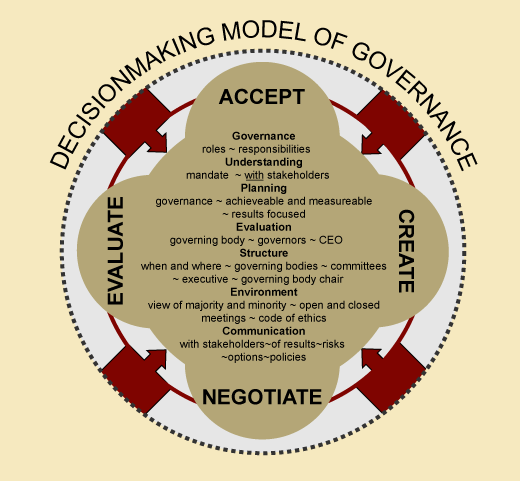
Please also see the following links for additional details about the Decision Making Model of Governance
Would you like a complimentary review of your governance policies? If so, follow this link Complimentary Governance Policy Report Card